Silesian Toponymy
The Origin and Meaning of Place Names
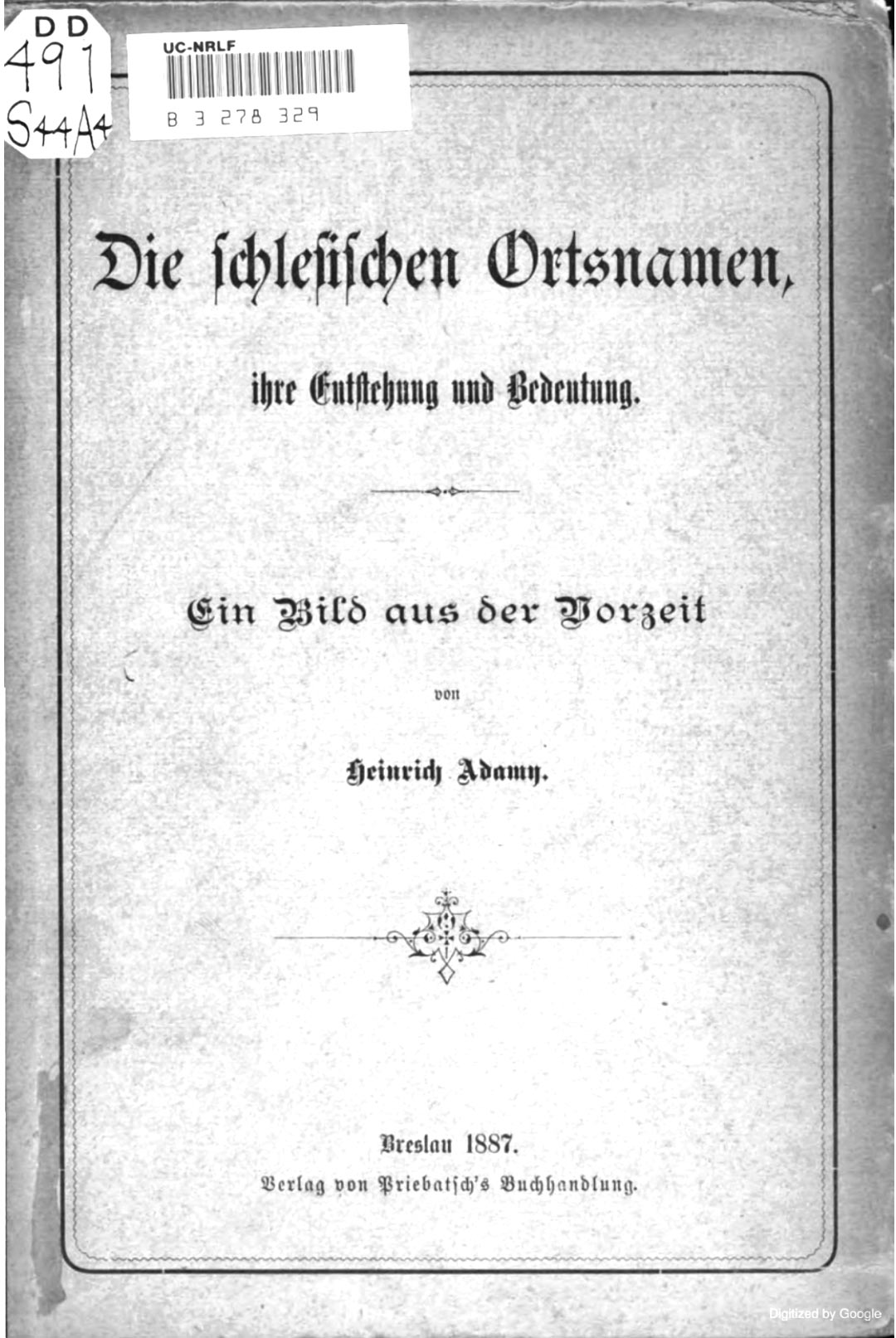
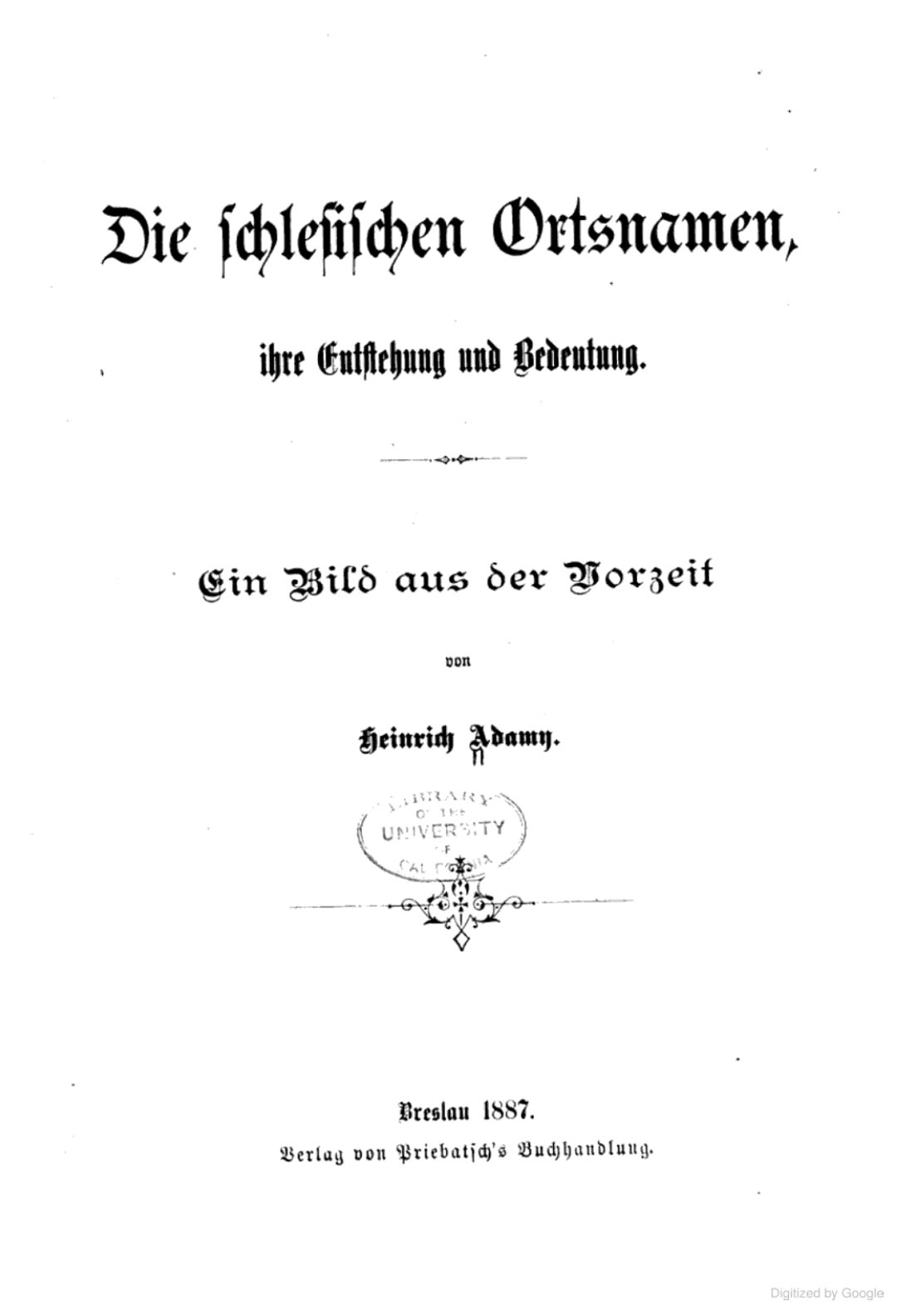
Place names are the only surviving witnesses to conditions of long-past days. Heinrich Adamy's 1887 scholarly work "Die schlesischen Ortsnamen" (The Silesian Place Names) provides systematic documentation of how these linguistic artifacts preserve memory when all else has been erased.
For the Laboratory of Absence, toponymy represents a crucial form of linguistic archaeology: names that persist even when the cultures that created them have been displaced, expelled, or forgotten. The name Leschnitz itself derives from the Slavic root meaning "forest"—a reminder that settlement began with the clearing of primordial wilderness.
The Name Leschnitz
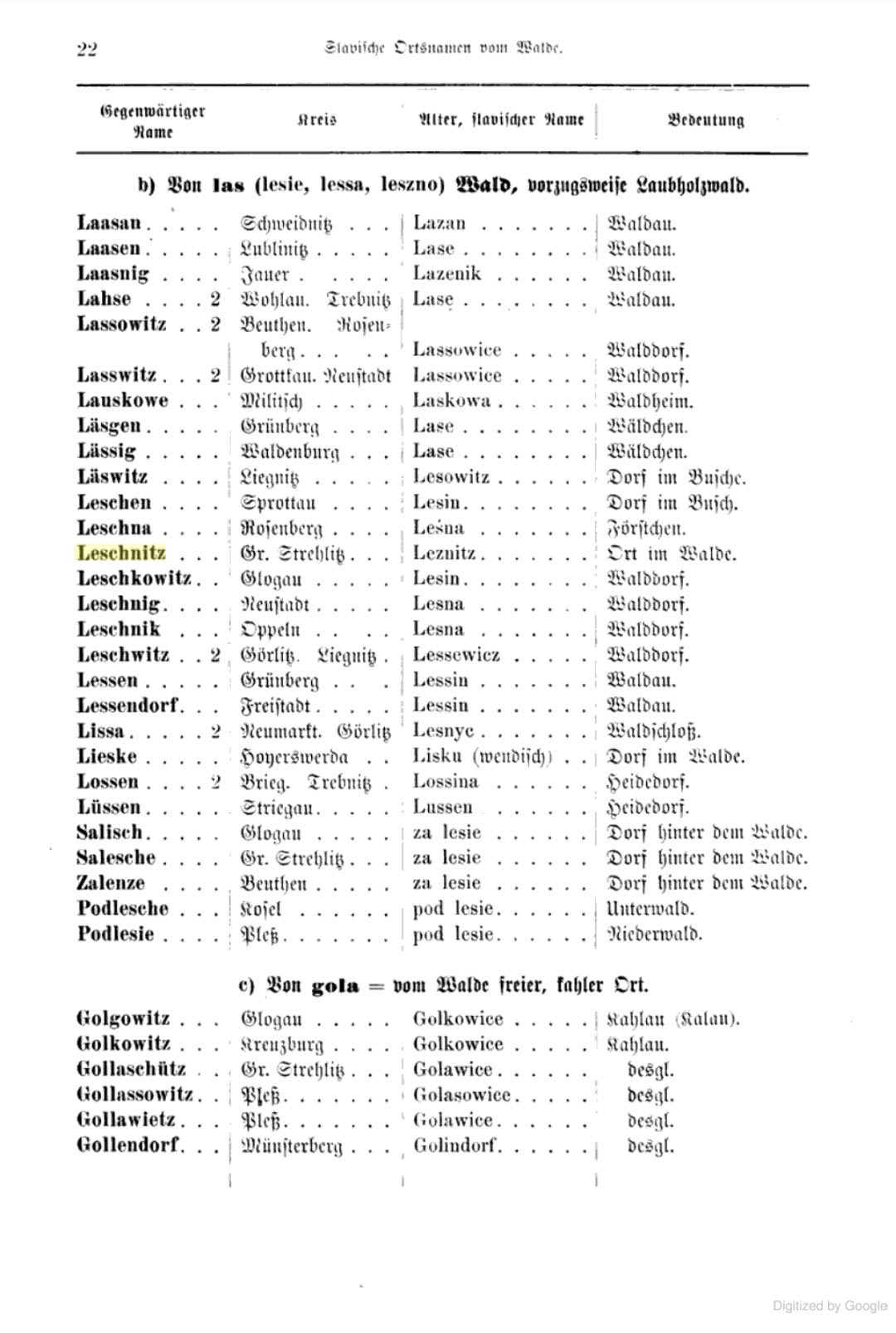
According to Adamy's classification, Leschnitz belongs to Group 7 of Slavic place names—names derived from forests (vom Walde). The entry on page 22 of his work records:
| German Name | Leschnitz |
|---|---|
| District | Gr. Strehlitz |
| Old Slavic Name | Leznitz |
| Meaning | Ort im Walde (Place in the Forest) |
The root les, lessa, leszno in Slavic languages means "forest" or specifically "deciduous forest." Related place names include:
- Laasan, Laasen, Laasnig, Lahse → Waldau (Forest settlement)
- Lassowitz, Lasswitz, Lauskowe → Walddorf (Forest village)
- Leschen, Leschna → Förstchen (Little forest)
- Leschkowitz, Leschnig, Leschnik → Walddorf (Forest village)
The name thus encodes the primordial condition of the land: dense forest that had to be cleared for settlement. The forest that once defined this place has been absent for centuries, yet its memory persists in the name.
Preface (1887)
"The present work has not only the purpose of presenting a picture of conditions in Silesia at the time of its first settlements, but also the intention of contributing to the clarification of many obscure place names. And indeed, the interpretation of these names is very suitable for providing information about the earlier conditions of the land and its inhabitants.
Place names are faithful and reliable reporters of facts, and in many cases the only surviving witnesses to conditions of long-past days.
Unfortunately, a large part of Silesian place names, because of the abbreviations and distortions they have suffered over many centuries, are not suited to render this service. Therefore it was first necessary to seek out the original form of the place names in order to recognize their meaning."
— Heinrich Adamy, Breslau, April 1887
Adamy's sources included the Silesian document collections, particularly the Regesten of Dr. C. Grünhagen, the scientific works of Professors Markgraf, Nehring, Weinhold, and Buttmann, and the "Overview of Silesian Settlements" by Knie.
Land and People in Ancient Times
Silesian place names, like all geographical names, are never meaningless sound combinations, but always the expression of a thought that filled the first settlers when they founded the place. Very often they wanted to show gratitude to their leader by choosing his name, while other times the location and soil conditions gave occasion to name the settlement accordingly.
The collision of languages created profound transformations:
"Where foreign peoples invaded a land and different languages came into manifold contact, as in Silesia, there many place names suffered such significant changes—as each side tried to make them pronounceable—that they have become almost unrecognizable today."
From the overwhelming number of names speaking of forest and swamp, we recognize the unceasing struggle of the colonists against these powers. The cultivated stretches were still scattered like islands in the sea within the immense forest that covered the land.
Key insight: Slavic and German place names are mixed almost everywhere in Silesia, yet so that in Upper Silesia the Slavic names predominate, and in Middle and Lower Silesia the German names. It would be a great error to conclude from Slavic place names that Slavic is spoken there. The language boundary is quite different; for the German immigrants in the Middle and Lower Silesian lowlands introduced the German language almost everywhere they significantly enlarged a settlement, but retained the Slavic place name.
I. Slavic Place Names (11 Groups)
Group 1: Fortress Names (Kastellaneien)
The oldest fortifications, established by Polish or Bohemian rulers for defense. Names derive from location, purpose, or the castellans who administered them. Examples: Breslau, Liegnitz, Schweidnitz, Glatz, Glogau, Sagan, Ratibor.
Note: Glatz derives from Kladsko, meaning "wooden fortress made of tree trunks."
Group 2: Fortified Cities, Castles, Monasteries
Settlements protected by fortifications or strong ring walls, later elevated to cities under German law.
Group 3: Names from Occupations of Serfs (Hörigen)
Villages named after the obligated services of their serf inhabitants:
- Strehitz, Lobkowitz → Hunter/Archer villages
- Liskau, Liskowitz → Fox-hunter villages
- Jelline, Jeltsch → Deer-hunter villages
- Bobrek, Bobrownik → Beaver-hunter villages
- Sokolnik, Zukelnig → Falconer villages
- Rybnik, Reibnitz → Fisher villages
- Bartnig, Bartkerei → Beekeeper villages
Group 4: Names from Founders
Villages named after their founders:
- Urbanowice = Village of Urban
- Jannowice = Village of Johann
- Belkau = Village of Bialek
- Polkwitz = City of Bolko
Group 5: Names from High Locations
Gorkau = Mountain village, and similar elevated settlements.
Group 6: Names from Low/Wet Locations
Mokrau = Swamp place, and settlements in lowlands or marshes.
Group 7: Names from Forests
This group includes Leschnitz and related names. See detailed etymology above.
Borau = Forest village (from bor, pine forest)
Group 8: Names from Tree Species and Plants
- Dombrowa = Oak hill (from dub, oak)
- Jawor = Maple place
Group 9: Names from Animals
- Jeltsch = Deer place (from jelen, deer)
- Wilkau = Wolf village (from wilk, wolf)
- Rakowitz = Crayfish village
Group 10: Names from Terrain and Soil
Kamin = Stone mountain
Group 11: Names from Administrative Purposes
- Sandowel, Poseritz = Court place, judgment site
- Panthen, Panthenau = Lordly village
- Biskupitz, Bischwitz = Bishop's village
- Münchwitz = Monk's village
Special Note: The "Lub-" Names
A semantically and phonetically related group expressing emotional attachment to place:
Lüben, Lauban, Lubom, Leubus, Leubusch, Lublinitz, Leobschütz, Lubschau, Lubthal, Lewin
All share similar meaning: Beloved place, friendly place, joy-valley—comparable to German names like Liebau, Liebenau, Liebenthal.
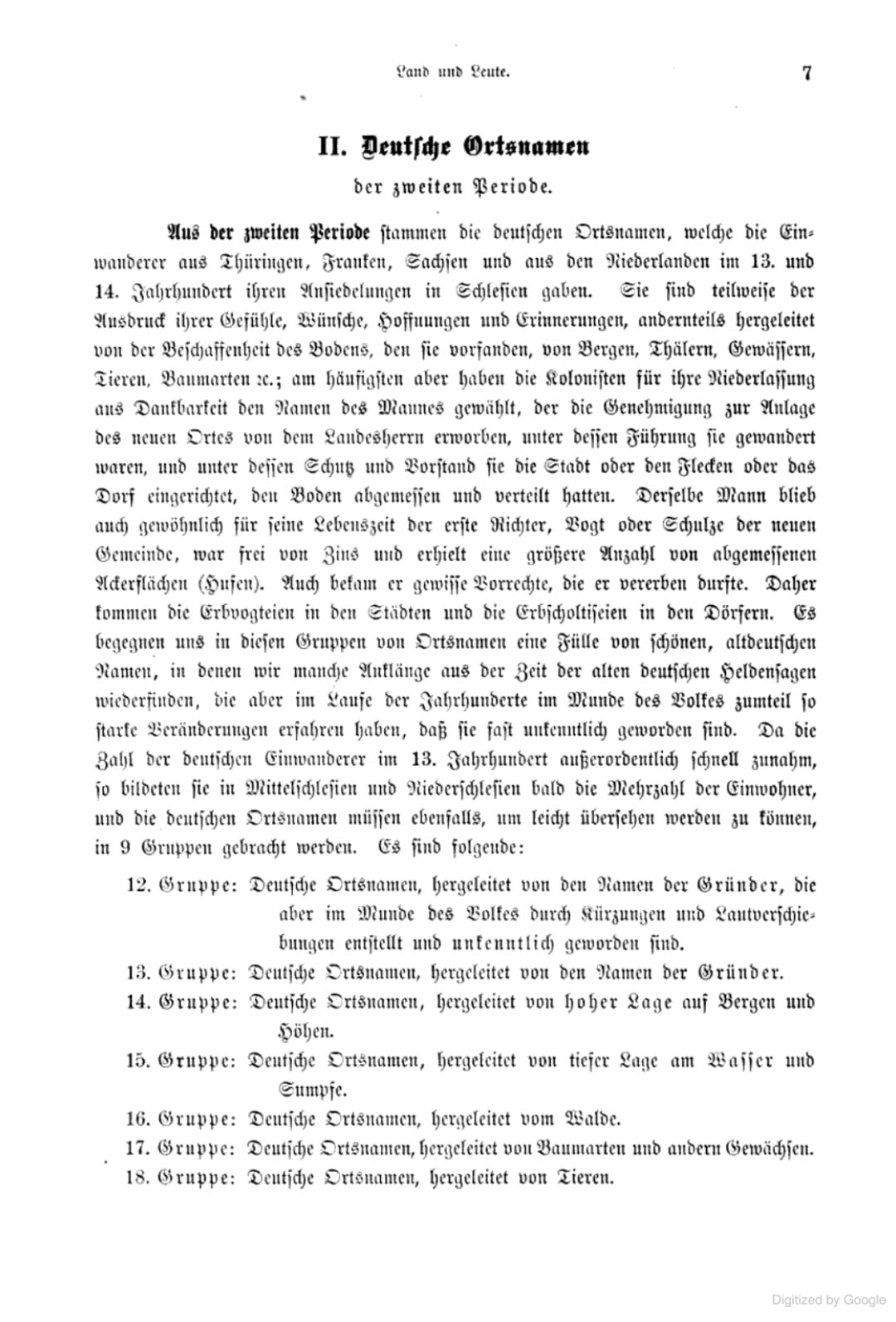
II. German Place Names (13th-14th Century)
German colonists from Thuringia, Franconia, Saxony, and the Netherlands arrived in the 13th and 14th centuries. Their place names express feelings, wishes, hopes, and memories, as well as the terrain they found.
Most commonly, colonists chose the name of the man who obtained permission from the territorial lord, under whose leadership they wandered, and under whose protection they established the town or village. This man usually remained the first judge, bailiff, or mayor for his lifetime.
Group 12: Distorted Founder Names
German names so altered through abbreviations and sound shifts that they have become unrecognizable.
Group 13: Recognizable Founder Names
Many beautiful old German names echo the time of ancient heroic sagas.
Groups 14-20: Terrain-Based Names
- Group 14: High locations on mountains and heights
- Group 15: Low locations at water and swamp
- Group 16: Forest-derived names
- Group 17: Tree species and plants
- Group 18: Animals
- Group 19: Terrain characteristics and soil components
- Group 20: Administrative and public purposes
Historical context: The mountain regions of Hirschberg, Löwenberg, Lauban, Landeshut, Waldenburg, Neurode, and Habelschwerdt are almost entirely free of Slavic place names. This indicates that at the time of German immigration, these mountain regions were still completely uninhabited and covered with primeval forest that also formed the border forest. The Germans founded the first settlements here, cleared the forests, and created access routes.
III. Prussian Period Names (post-1741)
Place names from the Prussian period (Group 21) date from 1741 onward, when Silesia became one of the most valuable provinces of the Prussian state. Particularly numerous are settlements created through the care of Frederick the Great for his newly acquired land.
Many of these names express Prussian patriotism by including names of the Prussian royal family and great men who served king and fatherland. Others owe their origin to mining, railways, or other favorable transport and economic conditions.
Understanding Suffixes
Slavic place name suffixes all carry the meaning of village, market town, place, colony, settlement:
| Suffix | Meaning | Notes |
|---|---|---|
| -witz | Village | Related to Latin vicus. Sometimes added to German roots to ease Slavic pronunciation (Birkwitz, Buchwitz, Peterwitz) |
| -itz | Place | Variant of -witz |
| -schutz | Settlement | Common in Upper Silesia |
| -in, -ine | Place | Feminine suffix form |
| -ow, -aw | Place | Transformed to German -au: Zoraw → Sorau (Crane-city), Glogow → Glogau (Hawthorn-city), Grottkow → Grottkau (Castle-city) |
Historical Document Gallery
The following images are scanned pages from Heinrich Adamy's original 1887 publication, "Die schlesischen Ortsnamen: ihre Entstehung und Bedeutung" (The Silesian Place Names: Their Origin and Meaning), published by Priebatsch's Buchhandlung in Breslau.